Involvement Report
From Framework to Action: Embedding Community Engagement and Involvement Across The George Institute for Global Health
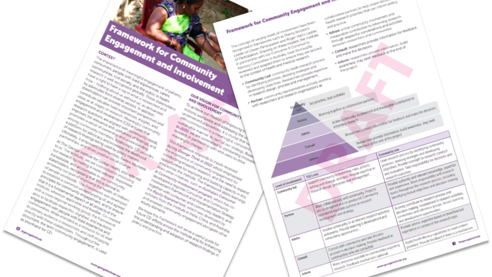
The George Institute for Global Health (TGI) has developed and is now implementing its first global Framework for Community Engagement and Involvement (CEI), designed to make engagement with communities, people with lived experience, and civil society a consistent and accountable part of all research practice.
From Framework to Action: Embedding Community Engagement and Involvement Across The George Institute for Global Health
Launch Date 18 September 2025
Author The George Institute
Location Australia, Oceania
Resource Type Publication
The George Institute for Global Health (TGI) has developed and is now implementing its first global Framework for Community Engagement and Involvement (CEI), designed to make engagement with communities, people with lived experience, and civil society a consistent and accountable part of all research practice.
This two-year initiative (2023–2024) emerged from an internal recognition that CEI across TGI’s global research portfolio was often fragmented and driven by individual champions. The goal was to move towards an institutional approach that establishes shared principles, expectations, and accountability mechanisms for CEI across diverse contexts.
A cross-regional working group—comprising researchers and engagement specialists from Australia, India, China, and the UK—met regularly over two years to guide the process. The group mapped existing CEI practice across programmes in injury prevention, NCDs, and health systems research, and reviewed global guidance including WHO’s Framework for Meaningful Engagement and the NCD Alliance’s Global Charter on Meaningful Involvement of People Living with NCDs. Drafts of the Framework underwent consultation across TGI and were strengthened through targeted feedback from external collaborators with expertise in participatory and equity-based approaches.
The resulting Framework articulates TGI’s shared vision for CEI, with six guiding principles—respect, trust, cultural safety, social inclusion, reflexivity, and sustained engagement—and a ladder of involvement adapted from established participation models. It also offers strategies and illustrative examples drawn from real-life projects to help researchers operationalise CEI appropriately within their contexts.
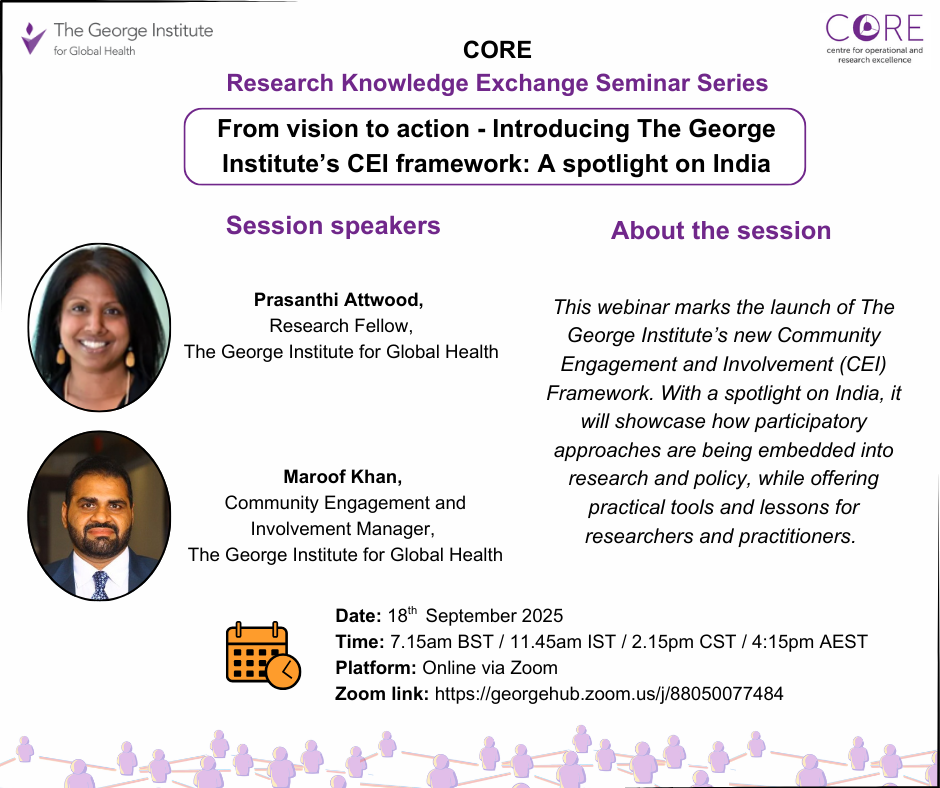
Since its launch in 2025 under the theme From Vision to Action, the Framework has served as a catalyst for deeper institutional reflection and capacity-building around meaningful involvement. Efforts are now focused on translating its principles into practice through guidance, learning opportunities, and community-driven collaborations across regions. These include the formation of a global Community of Practice on CEI, development of a baseline assessment using SPoT to monitor CEI integration across research projects, and creation of a CEI Capacity Development Programme that embeds training modules within existing institutional structures. Early evidence of impact includes growing demand for CEI support across programmes, integration of CEI indicators into project design templates, and stronger cross-regional collaboration on community-led approaches.
TGI is preparing to publish a summary of the Framework and its guiding principles on its website, accompanied by select excerpts and case examples. This will serve as a reference document for partners and funders while ensuring consistency with the internal Framework. By embedding CEI within institutional systems rather than as a standalone activity, TGI’s Framework illustrates how global health organisations can create an enabling environment for sustained, equitable partnerships with communities—shifting engagement from isolated examples towards an integrated culture of co-creation and shared ownership.
Further Activity Reports
Community engagement
Test Activity
Community engagement
Building a resilient, inclusive and people-centered NCD response in Vietnam